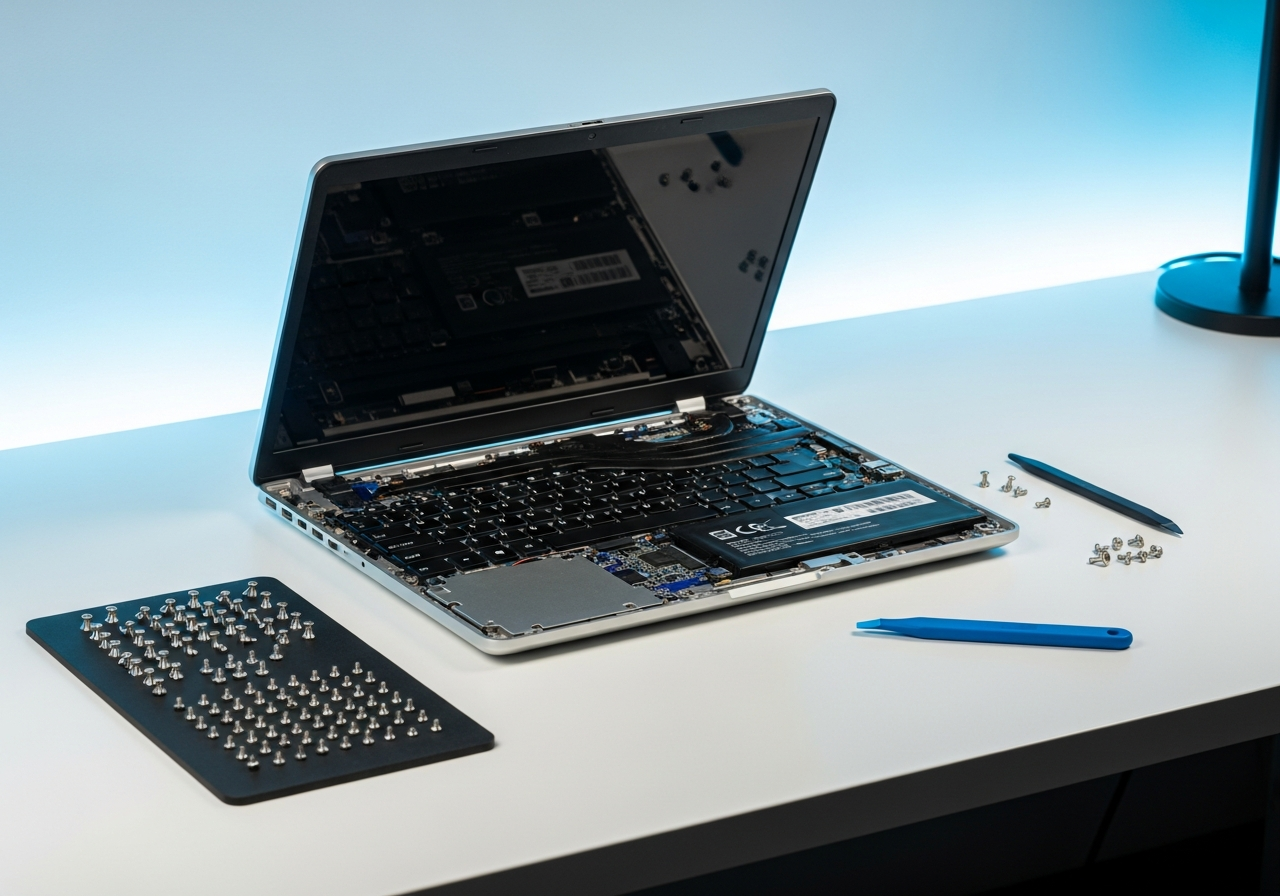
What You Will Learn
The sections below walk through the underlying concepts, the most common failure points, and a structured way to think about diagnosis — all written for learners, not technicians on the clock.
Introduction
Laptops represent a unique engineering challenge in consumer electronics: all the computational power of a desktop computer compressed into a portable package weighing 1-3 kilograms. Achieving this miniaturization needs engineering tradeoffs that directly influence how laptops fail and how their failures manifest as checking symptoms.
Unlike desktop PCs where parts are large, modular, and easily accessible, laptops integrate their parts in compact, often non-standard setups. Many parts.
Particularly in ultra-thin designs. Are soldered directly to the motherboard rather than inserted into sockets, eliminating the possibility of individual part spare.
Understanding this architectural difference is core to laptop repair knowledge.
This article gives a complete overview of laptop architecture, the most common failure modes specific to portable computing. And the systematic approach to checking laptop problems.
The knowledge here applies broadly across laptop designs from different makers and form factors.
Core Concepts
A laptop motherboard integrates parts that in a desktop would be spread across multiple boards: the CPU. GPU (in non-discrete GPU models), memory controller, I/O controllers.
And often even the RAM itself are either soldered directly to or integrated within the main board. This integration gives space savings and power speed but greatly reduces repairability.
Thermal Design in Compact Spaces
Laptops face a at its core harder thermal challenge than desktops. The same computational performance must be achieved within a form factor that allows less than a third of the cooling volume available in a desktop.
Laptop cooling systems rely on heat pipes. Sealed copper tubes holding a working fluid that evaporates at the hot end (CPU/GPU) and condenses at the cooler end (heatsink fin stack).
This phase-change heat transport is far more fast than solid metal conduction. This allows heat to be moved efficiently from cramped part areas to the fan exhaust.
Battery and Power System
Laptop power systems are a lot more complex than desktop power systems. The battery management system (BMS) monitors cell voltages, temperatures.
And charge/discharge rates to protect the lithium cells from dangerous working conditions. The charging circuit must handle power from multiple sources (AC adapter, USB-C PD), control voltage precisely.
And gracefully manage the transition between battery and external power. Failures in any part of this complex power system can manifest as failure to charge.
Sudden shutdowns, or inaccurate battery percentage readings.
Technical Deep Dive
Laptop electronics work under more stringent power budgets than desktop systems. While a desktop CPU might consume 65-250W, equivalent laptop CPUs are constrained to 15-45W.
Requiring architectural optimizations that deliver comparable performance within a fraction of the power envelope. Understanding these power budgets helps explain why laptop parts are built, specified.
And in the end fail differently from their desktop counterparts.
Display Systems
Laptop displays are multi-layer assemblies: an LCD panel, a backlight (LED array or rarely. Cold-cathode in older models), a digitizer layer (in touch models).
And the glass/plastic covering. Each layer can fail independently.
The LCD panel may develop dead pixels or sections from physical pressure damage. The backlight LEDs may dim unevenly over time.
The display cable running through the laptop hinge area experiences repeated flexion and is a common point of failure. This causes on-and-off display problems that worsen as the hinge area ages.
Hinge Mechanism and Chassis
The hinge mechanism connecting the display lid to the base is a mechanical part subjected to thousands of open/close cycles over a laptop's lifetime. Hinges use friction-based mechanisms to keep the display at any angle.
These friction elements wear over time. This causes loose hinges that won't hold the display position, or in some cases.
Hinges that stiffen and crack the display bezel or back cover when opened. The hinge area also holds the display cable, antenna cables for wireless, and sometimes the webcam cable.
All of which experience stress with every hinge work.
Modern laptop designs increasingly integrate parts that were once modular. RAM is often soldered to the motherboard in thin and light designs.
SSDs that used to be easily replaceable M. 2 modules are sometimes soldered as well.
This trend toward integration, driven by size and speed requirements. Means that the repair knowledge domain for laptops increasingly overlaps with the more complex soldering and board-level repair knowledge traditionally associated with smartphones.
The hinge area is the single most mechanically stressed location in any laptop. Display cables routed through hinges experience tens of thousands of flex cycles over a laptop's lifetime. Far exceeding what any electrical part was built for. This makes hinge-area cable failure one of the most likely and diagnosable laptop failures.
Common Issues and Causes
Laptop failures happen in likely patterns related to their unique form factor and usage patterns:
- Display cable failure: The cable connecting the motherboard to the display runs through the hinge and flexes with every open/close cycle. In time developing on-and-off shorts or opens.
- Battery degradation: Lithium batteries naturally degrade with charge cycles, usually losing 20% capacity within 2-3 years of regular use.
- Thermal paste dryout: The thermal interface material between CPU/GPU and heatsink dries and loses effectiveness within 3-5 years. This causes rising temperatures and throttling.
- Charging port damage: DC barrel jacks and USB-C ports experience mechanical stress from plugging/unplugging. In time developing loose connections or internal damage.
- Keyboard failures: Laptop keyboards use thin membrane or chiclet designs with limited mechanical depth. Spilled liquids or physical damage cause key failures.
- Fan bearing failure: The single laptop cooling fan works at high RPMs all the time under load. And its bearings wear over years of use.
Many of these failure modes are progressive and likely. Meaning that attentive monitoring can spot impending failures before they cause data loss or complete system failure.
Laptop batteries are potentially hazardous. Damaged, punctured, or bloated lithium batteries can catch fire or explode. If a laptop battery appears swollen (pushing up the trackpad or causing the bottom case to bow). Do not charge or use the device. Handle damaged batteries with extreme care and dispose of them through right channels.
Diagnostic Framework
Laptop check follows the same systematic rules as desktop check but must account for the greater integration and part interdependencies specific to portable designs.
Step-by-Step Knowledge Framework
- Identify the problem domain: display, power, performance, connection, or input device.
- Determine if the problem is consistent or on-and-off. On-and-off problems often show mechanical connections (cables, connectors) rather than part failures.
- Test with external peripherals where possible. An external display can bypass the laptop display system to find out if the problem is in the panel/cable or the GPU/motherboard.
- Check power supply: check the AC adapter outputs the correct voltage, check the charging indicator. And test with battery took out if applicable.
- Check accessible areas: look for liquid damage indicators (often red or pink stickers inside the battery compartment), check for debris in ports.
- Use checking software: system firmware checks, hardware test utilities, and temperature monitoring tools give hardware-level feedback.
The non-modular nature of laptops means that check must be more precise than desktop check. Ruling out software and cable problems before considering part spare is especially key.
Before concluding that a laptop motherboard has failed, always test with an external keyboard, external mouse, external display. And known-good power supply. Many laptop "motherboard failures" are actually display cable failures, power adapter failures. Or keyboard controller problems that are checked only after systematic external part testing.
Summary Reference Table
| Aspect | Description | Notes |
|---|---|---|
| Display | LCD panel, display cable, backlight | Test with external display to isolate |
| Power | Battery, charging circuit, DC jack | Test with known-good adapter, check battery health |
| Input | Keyboard, trackpad, touchscreen | Test with external keyboard/mouse |
| Thermal | Fan, heat pipe, thermal paste | Monitor temperatures under load |
| Storage | M. 2 SSD, SATA drive, eMMC | drive health data, file system check |
| Wireless | WiFi/BT module, antenna cables | Check device manager, test module spare |